Доступна русская версия сайта
- Поддержка на русском языке
- Оплата российскими картами
На этом сайте принимаются только международные карты
Which Jobs AI Will Replace and Which Will Stay with People
We look at which professions artificial intelligence will replace in the next 10 years, which jobs in IT, creative fields and construction are at risk, and which AI will never be able to replace.
Free access to Chat GPT and other neural networks
 Open Chat →


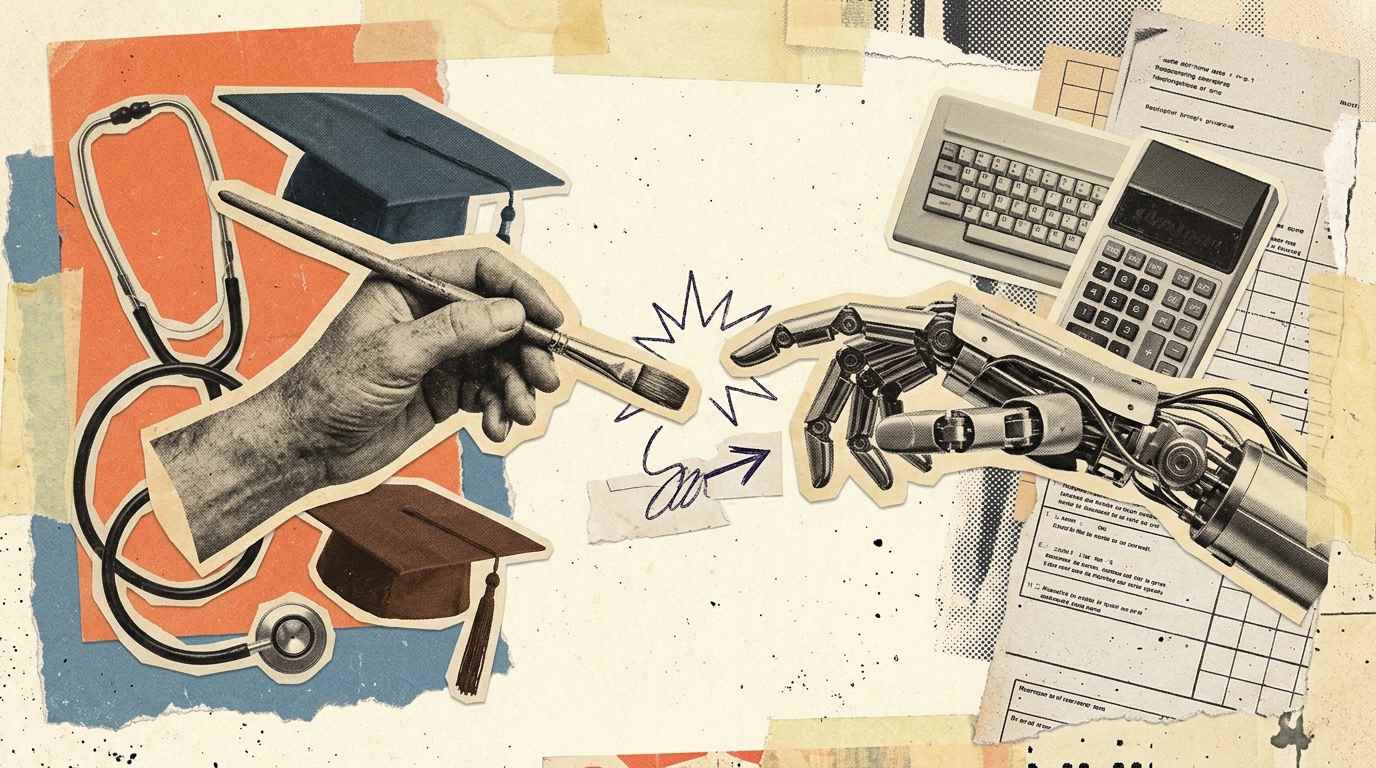
The question of automating jobs usually comes down to extremes: either "AI will replace everyone" or "it's just a trendy toy". The truth is somewhere in the middle. Which jobs AI will replace in the next 10 years is not an abstract question but a practical one: it's about specific operations within a profession, not the whole position.
The breakdown below is built around three groups: positions that are genuinely being replaced already; professions AI won't replace because of the role of empathy and responsibility; and a large middle group where it's not the job title that changes, but the set of tasks within it.
Jobs AI will replace in the next 10 years
Automation comes faster where a task is repeated according to a template and the result is easy to check.
These professions include:
- entry-level copywriters: template texts, SEO descriptions and rewriting are already partly being replaced;
- technical translators: neural networks translate simple texts more accurately and faster;
- junior lawyers: drafting template contracts and initial document review;
- call center operators: chatbots handle a significant share of typical questions;
- bookkeepers handling primary documents: document recognition, standard entries, report generation;
- analysts producing routine reports: data aggregation and basic visualization.
In all these cases it's not about the whole profession, but about its basic, most mechanical layer. A specialist who can only repeat a template without additional expertise is in the risk group.
The speed of replacement differs by profession: where work is strictly regulated — accounting, standard legal documents — automation goes faster thanks to clear standards that are easier to build into an algorithm.
The overall list of jobs AI will replace in the coming years keeps growing as models develop, but its core stays the same: tasks with a clear template, a large volume of repetition and a verifiable result. As soon as a task stops fitting a template, automation becomes much harder.
Jobs AI won't replace
There are professions where automating the basic layer doesn't affect the essence of the work, because their value isn't built on a repeatable operation.
They include:
- doctors: diagnosis requires empathy, complex thinking and personal responsibility for the decision;
- psychologists and psychotherapists: working with emotions, trauma and crises requires live contact;
- teachers and mentors: motivation, an individual approach and upbringing can't be reduced to a template;
- strategists and executives: decisions under uncertainty require context the model doesn't have;
- high-level creative professions: directors, writers and artists with a unique style;
- craftspeople: complex motor skills and work with non-standard materials.
Which jobs AI can't replace is a good filter for understanding the general pattern: the greater the role of personal responsibility, empathy and a unique style, the further a profession is from automation. The question of which creative jobs AI will replace often sounds louder than others, but it's precisely an author's style and personal touch that remain beyond confident automation for now.
If you narrow the question down to one sentence: the jobs AI won't replace are those where the cost of a mistake is high and the decision requires live contact with a person, not just processing information. A doctor makes a diagnosis not only from the symptoms in the medical record, but also from how the patient describes their condition — and the model doesn't fully pick up this context.
It's a similar story with a teacher: a topic can be explained with a video or text, but only a person in the room can notice from a student's face and reaction to a question that they've stopped following the material.
Jobs that will change but not disappear
Between the two extremes — complete replacement and complete immunity — lies the largest group of professions.
They include:
- programmers: AI writes code, but architects, reviewers and DevOps specialists are still needed;
- marketers: routine goes away, while strategy, creativity and in-depth analytics remain;
- designers: AI generates mockups, but art directors and UX researchers are still needed;
- journalists: news items are written by bots, but investigations and interviews stay with people.
In this group the profession doesn't disappear but changes the set of tasks within it: the mechanical part goes away, and the share of strategic and creative work grows. This is the most common scenario in practice, more likely than a profession disappearing completely.
A telling example is the designer's profession. Ten years ago a large part of the time went into drawing standard layouts and banner variations. Today a generative tool increasingly takes over this part, and the designer focuses on the concept, the user experience and aligning the solution with the client's business goal.
A similar dynamic can be seen in law: a junior lawyer who used to spend a day picking standard wording now checks a draft prepared by the model and frees up time for complex or disputed cases.
What to do to stay employed
Which jobs AI will replace in the future depends on how fast technology develops, but the general direction is already clear: the mechanical part of the work is automated, not expertise as a whole.
A few practical directions:
- learn to work with AI: prompt engineering is becoming a new basic skill in most specializations;
- develop what AI can't do: empathy, strategic thinking, a personal creative touch;
- become an expert in a narrow field: AI replaces routine, but not deep expertise and personal responsibility for a decision;
- regularly review the set of tasks in your work: what was manual a year ago may already be automated today.
It's important not to confuse anxiety about a new technology with a real risk to a specific job: in most cases the set of tasks changes first, rather than the specialist's role disappearing entirely.
Often it's not about changing professions entirely, but about shifting focus within one: an accountant gradually becomes a financial analyst, and a copywriter becomes an editor and content strategist, staying in the same professional field.
The practical guideline is simple: if your work includes a task you've been doing the same way for the third year in a row, it will be the first to be automated. Tasks that require a new solution for each specific situation will stay with people for a long time.
Waiting until your employer explicitly demands new skills is risky: specialists who master tools in advance are in a better position when job responsibilities and salaries are reviewed.
chataibot.pro helps you master neural networks for any line of work. Whether you're an accountant or a marketer, the platform has a tool that will make your work easier and make you noticeably more effective in your role.
Free access to Chat GPT and other neural networks
Open Chat →
You might also like
-
 Chat AI
How Neural Networks Help Businesses Make Money
Chat AI • -
 Chat AI
How to Create a Product Card with AI
Chat AI • -
 Chat AI
What Tasks Artificial Intelligence Can Solve
Chat AI • -
 Chat AI
How a Neural Network Can Help in Sales
Chat AI • -
 Chat AI
Examples of AI in Business: How Companies Use Neural Networks in Practice
Chat AI • -
 Chat AI
Neural Networks for Startups
Chat AI • -
 Chat GPT
How neural networks help business
Chat AI • -
 Chat GPT
Feedback Generator
Chat AI • -
 Chat GPT
Letter generator
Chat AI • -
 Chat GPT
Earnings in Chatgpt
Chat AI • -
 Chat GPT
How to write a business letter using a neural network
Chat AI • -
 Chat GPT
ChatGPT Prompts for Sales
Chat AI • -
 Chat GPT
ChatGPT Requests for Business
Chat AI • -
 Chat GPT
ChatGPT for Business
Chat AI • -
 Chat GPT
Earning with ChatGPT
Chat AI •